Industry Report
Pharma & Healthcare
Private healthcare market in Poland 2026
Market analysis and development forecasts for 2026-2031

In 2024, as many as 56% of adult Poles used private healthcare services, according to an analysis prepared by PMR Market Experts by Hume’s. For a growing number of patients, the private sector is becoming not only an alternative to the public healthcare system but also an important supplement where access to National Health Fund (NFZ) services is limited. Furthermore, 59% of respondents believe that private healthcare provides better treatment outcomes than the public system. Modern forms of contact with doctors—including online consultations—are also gaining popularity.
According to the report “The Private Healthcare Market in Poland 2025,” 58% of Poles plan to use private medical services in 2025, covering the costs out of their own pockets under the FFS (fee-for-service) model. Among this group:
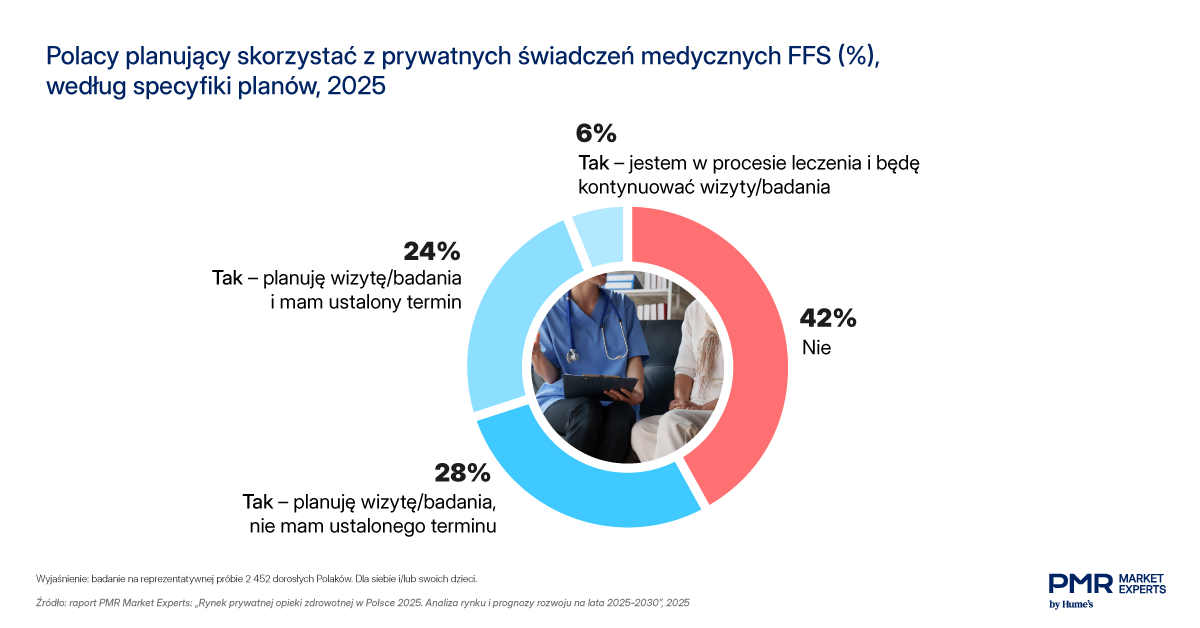
Nearly 60% of Poles view the quality of private healthcare positively, noting that it is more effective than the public system. By comparison, only 22% of respondents rate the level of services provided by the National Health Fund (NFZ) favorably. The choice to opt for the private sector is increasingly motivated not only by shorter wait times, but also by a higher standard of care and better treatment outcomes.
Poland remains one of the European Union countries with a relatively low level of healthcare spending, both per capita and as a percentage of GDP. Despite this, the private healthcare services sector is growing steadily. According to an analysis by PMR Market Experts by Hume’s, its value—excluding pharmaceuticals and medical devices—will grow at an average annual rate of 7.6% through 2030.
At the same time, despite the growing share of public funding in total health care spending, the private sector will continue to grow rapidly. For many people, it serves as an important supplement to the public system, especially given the limited availability of specialists and long wait times for care.
The growing demand for private health care services is opening up new opportunities for medical service providers. Significant growth potential is evident in areas such as:
Data for 2024 shows that 55% of private health insurance subscribers have used remote consultations—by phone, chat, or video call. Although in-person visits still dominate (96% of patients report using them), interest in remote solutions is growing—especially among people under 55.
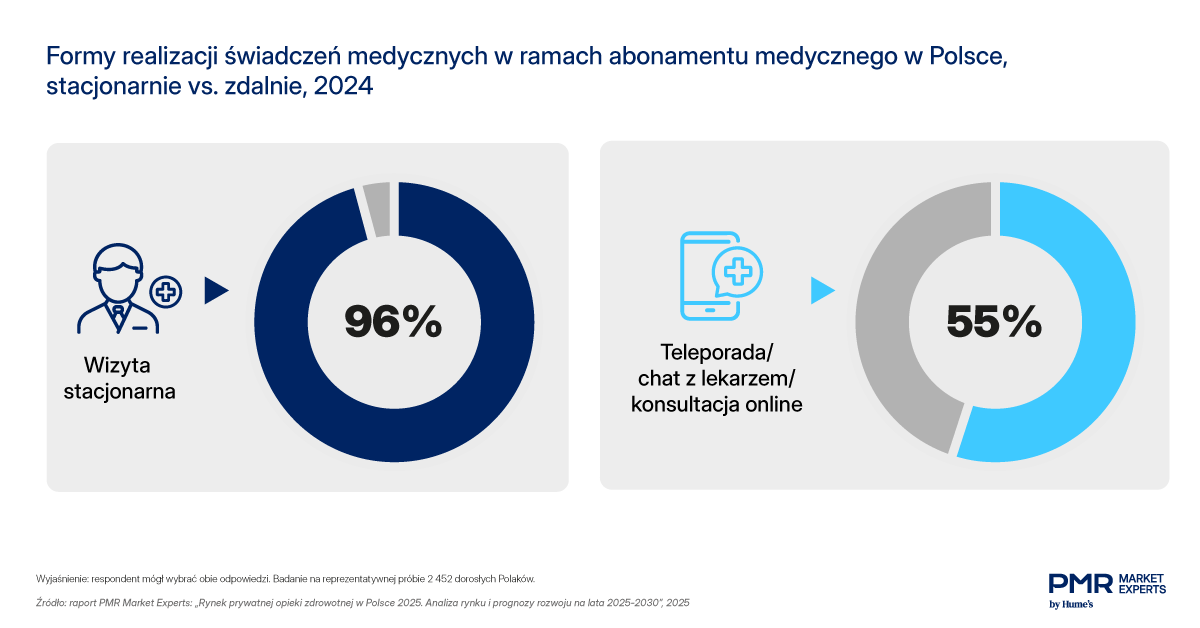
Teleconsultations are most often used for simple health needs—such as issuing a prescription, a medical certificate, or a sick leave note—and as a “filter” that allows for an initial assessment of a patient’s health and directs them to the appropriate diagnostic and treatment pathway, without having to wait for a traditional in-person visit.
Marta Marszałek
Head of Pharmaceutical & Healthcare Market Analysis
Demographics clearly influence the future of both the public and private sectors. According to our projections, by 2050, the share of people over 80 in Poland’s population will rise from 4% to over 9%, representing an increase of approximately 1.5 million seniors.
The growing number of elderly patients—including those with disabilities—will require:

Industry Report
Pharma & Healthcare
Market analysis and development forecasts for 2026-2031
OTHER BLOG POSTS: