Industry Report
Digital & ICT
Telecommunications services for business and carrier segment in Poland 2026
Market analysis and development forecasts for 2026-2031

In 2025, the value of the telecommunications services market for the business and operator sectors in Poland grew by 3% year-over-year. However, this growth is increasingly less driven by the acquisition of new users of basic services. Prices, ARPU, migration to fiber optics and 5G, the development of M2M, and the sale of higher-performance services are becoming increasingly important. According to the latest report by PMR Market Experts by Hume’s “The Telecommunications Market for the Business and Operator Sectors 2026,” the market is gradually shifting from growth based on the number of new customers to a model in which service quality, technology, and the value generated per customer play an increasingly important role.
– The B2B telecommunications services market is entering a phase where simply increasing the number of customers is no longer enough. Operators must generate more and more value from their existing customer base through higher speeds, fiber optics, 5G, greater reliability, and value-added services. Volume remains important, but the quality and value of each individual customer are becoming increasingly significant.
Patryk Gawłowicz
ICT Market Analyst
In terms of potential customer base, the business market is in a much more favorable position than the consumer market. While Poland’s population is steadily declining, the number of active businesses continues to grow, providing operators with new customers.
However, most of the newly established businesses are micro and small companies. Although they increase the overall number of users, they typically opt for simpler service plans and generate lower revenues than medium-sized and large enterprises. As a result, the growth in the number of companies primarily drives market volume, while growth in market value depends to a greater extent on pricing policies and the types of services purchased.
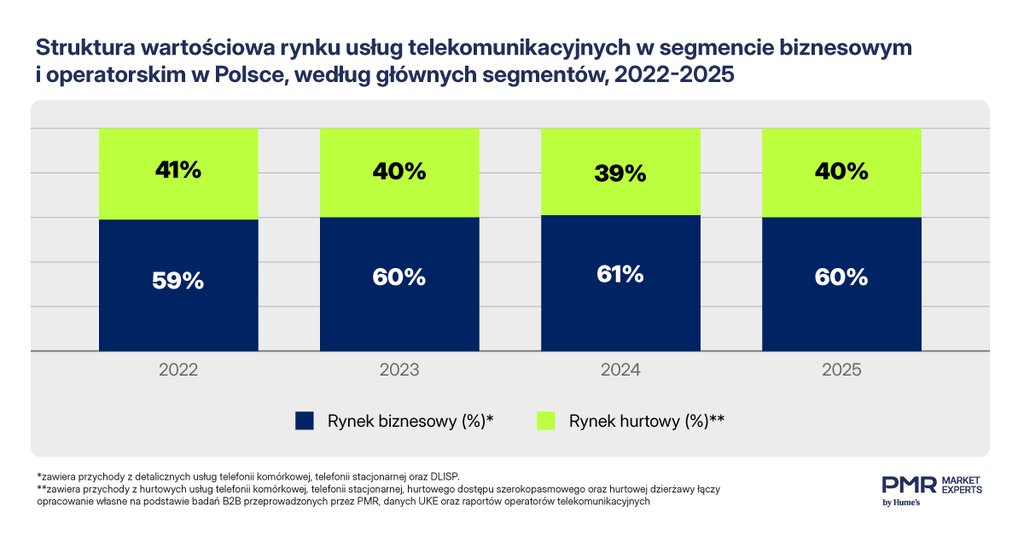
The number of SIM cards used by businesses is steadily growing, but an increasing portion of this growth is driven by devices rather than users themselves. However, the M2M (machine-to-machine) segment remains the most significant source of volume growth. In 2025 alone, the number of M2M SIM cards increased by 40% year-over-year, reaching 14 million, driven by the rapid digitization of processes, monitoring, logistics, and the development of the Internet of Things (IoT).
In the case of fixed-line Internet, the penetration rate among businesses has remained at a similar level for the past three years. The growth in the value of this segment stems mainly from the migration to fiber-optic connections and lines with higher bandwidth and greater reliability. At the same time, among microenterprises, mobile internet remains a strong competitor to fixed-line access, supported by the growing coverage and capabilities of 5G.
Traditional landline telephony, on the other hand, is steadily losing ground and accounts for less than 6% of the market value.
In 2025, an improvement in the wholesale market was also evident, thanks in part to the completion of the phase of regulatory reductions in MTR rates. Wholesale broadband access under the BSA model is becoming an increasingly important pillar of this segment. Operators are increasingly providing services over other entities’ networks, while specialized infrastructure companies are developing open fiber-optic networks. According to UKE data, more than 2 million fixed-line Internet services—that is, one-fifth of all connections—are currently provided based on the BSA and LLU models.
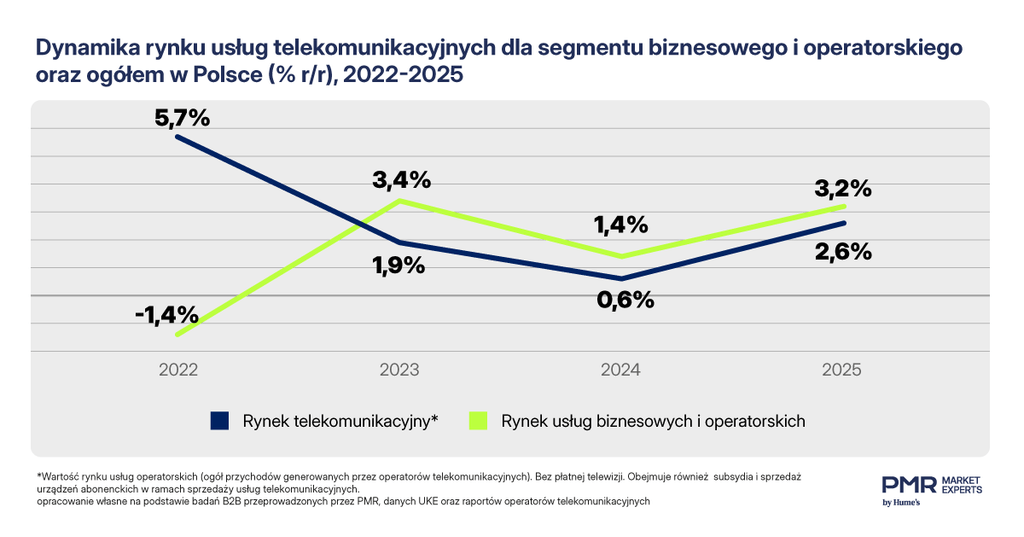
PMR Forecasts by PMR Market Experts by Hume’s indicate that the market for telecommunications services for the business and operator sectors will continue to grow between 2026 and 2031. The wholesale segment will grow faster (with a compound annual growth rate [CAGR] of 5%), while the B2B retail services segment will achieve a CAGR of 2%.
– The outlook through 2031 remains positive, but the source of growth is shifting. In the wholesale market, open networks will become increasingly important, while in the retail market, the ability to monetize quality, higher speeds, reliability, security, and value-added services will become crucial. It is precisely on these elements that operators will increasingly build customer value.
Patryk Gawłowicz
ICT Market Analyst

Industry Report
Digital & ICT
Market analysis and development forecasts for 2026-2031
OTHER BLOG POSTS: