Industry Report
Retail
Grocery retail market in Poland 2026
Market analysis and development forecasts for 2026-2031
The Polish grocery market has reached maturity, and the success of individual retail formats will be determined less and less by the number of stores or price alone. According to our latest report, “Food Retail in Poland 2026,” consumers are increasingly spreading their purchases across different sales channels. The biggest beneficiaries of this shift will be discount stores, proximity supermarkets, and convenience stores.
Our data indicates that the structure of the Polish food market is already largely established. In the coming years, the growth of individual retail channels will result primarily from shifts in consumer spending patterns across different formats, rather than from dynamic growth of the market as a whole.
Consumers are increasingly less likely to do all their shopping in one place. Instead, they choose the channel that best suits their specific needs—whether it’s for big-ticket purchases, everyday restocking, impulse buys, or a quick stop on the way home.
– We’re seeing that competition among retail chains is increasingly defined by consumers’ shopping missions. Customers no longer choose a single store—they choose the format that best suits a specific shopping situation. It is precisely this alignment with customer needs that will be the most important growth
factor in the coming yearsAgnieszka Skonieczna
, Head Retail Market Analyst
Discount stores will remain one of the fastest-growing channels in the grocery market. According to experts at PMR Market Experts by Hume’s, their average annual growth rate from 2026 to 2031 will be approximately 6%. The main purpose of these stores is to accommodate top-up shopping—that is, purchases made before larger, planned shopping trips.
The most commonly cited reasons for visiting discount stores are small weekly purchases (64%), planned bulk purchases (55%), and stocking up on products (48%). At the same time, the customer profile is changing. Increasingly, these customers are households with incomes above the median, although the channel continues to serve a mass market.
– Discount stores are no longer chosen solely for their low prices. For many consumers, they have become the primary place to buy groceries, regardless of income level.
Agnieszka Skonieczna
, Head Retail Market Analyst
Proximity supermarkets will also grow faster than the overall grocery market, achieving an average annual growth rate exceeding 5% from 2026 to 2031. Dino’s continued expansion remains the biggest driver of growth, particularly in smaller towns and suburban areas.
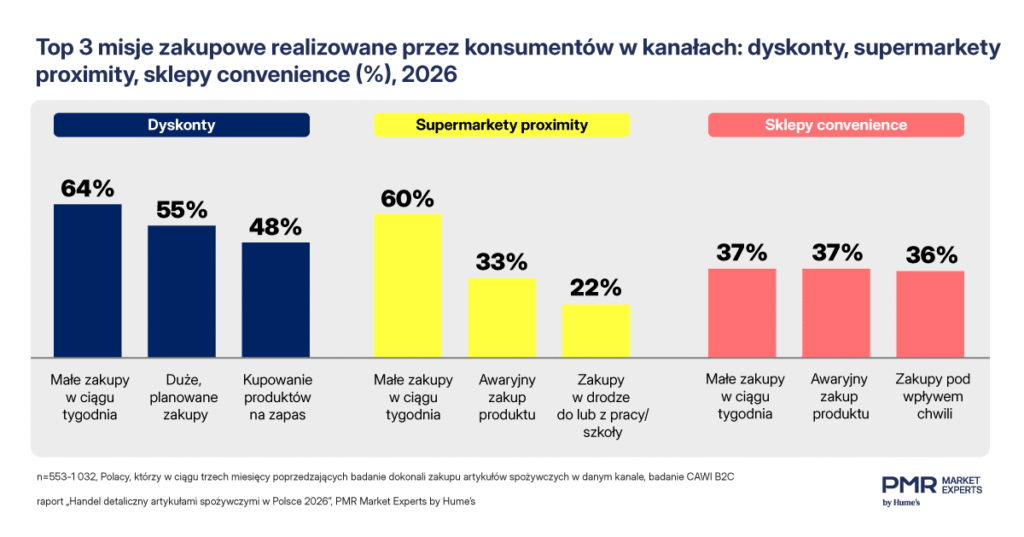
It is precisely this model of the chain’s development that has largely shaped the consumer profile of the entire channel. A typical customer of “convenience” supermarkets is a consumer living in a rural area or a small town who visits the store regularly, primarily to meet their day-to-day shopping needs. Most often, they make small top-up purchases (60%), buy a missing item (33%), or stop by the store on their way to work or school (22%).
– Discount stores are no longer chosen solely for their low prices. For many consumers, they have become the primary place to buy groceries, regardless of income level.
Agnieszka Skonieczna
, Head Retail Market Analyst
The convenience channel will also grow faster than the market as a whole, achieving an average annual growth rate of nearly 6%. Its future will be determined largely by the continued expansion of Żabka and the growing importance of value-added services.
The profile of a convenience store customer differs significantly from that of the average grocery shopper. These customers are primarily Millennials and Generation Z, residents of large cities, and people with relatively higher incomes.
Convenience stores primarily serve as a quick way to stock up on everyday essentials. Our research shows that the most common types of purchases made there are small top-up purchases (37%), emergency purchases (37%), and impulse purchases (36%).
– For younger consumers, convenience is becoming part of their everyday lifestyle. What matters is not only the ability to quickly purchase products, but also convenience, food options, and services all available in one place.
Agnieszka Skonieczna
, Head Retail Market Analyst
Our experts’ forecasts indicate that in the coming years, retail formats with a clearly defined shopping role will gain the upper hand. Discount stores will remain the go-to place for bulk shopping, proximity supermarkets will handle daily grocery runs, convenience stores will cater to quick purchases on the go, and online shopping will gradually strengthen its position among consumers who value convenience.

Industry Report
Retail
Market analysis and development forecasts for 2026-2031
OTHER BLOG POSTS: