Industry Report
Construction
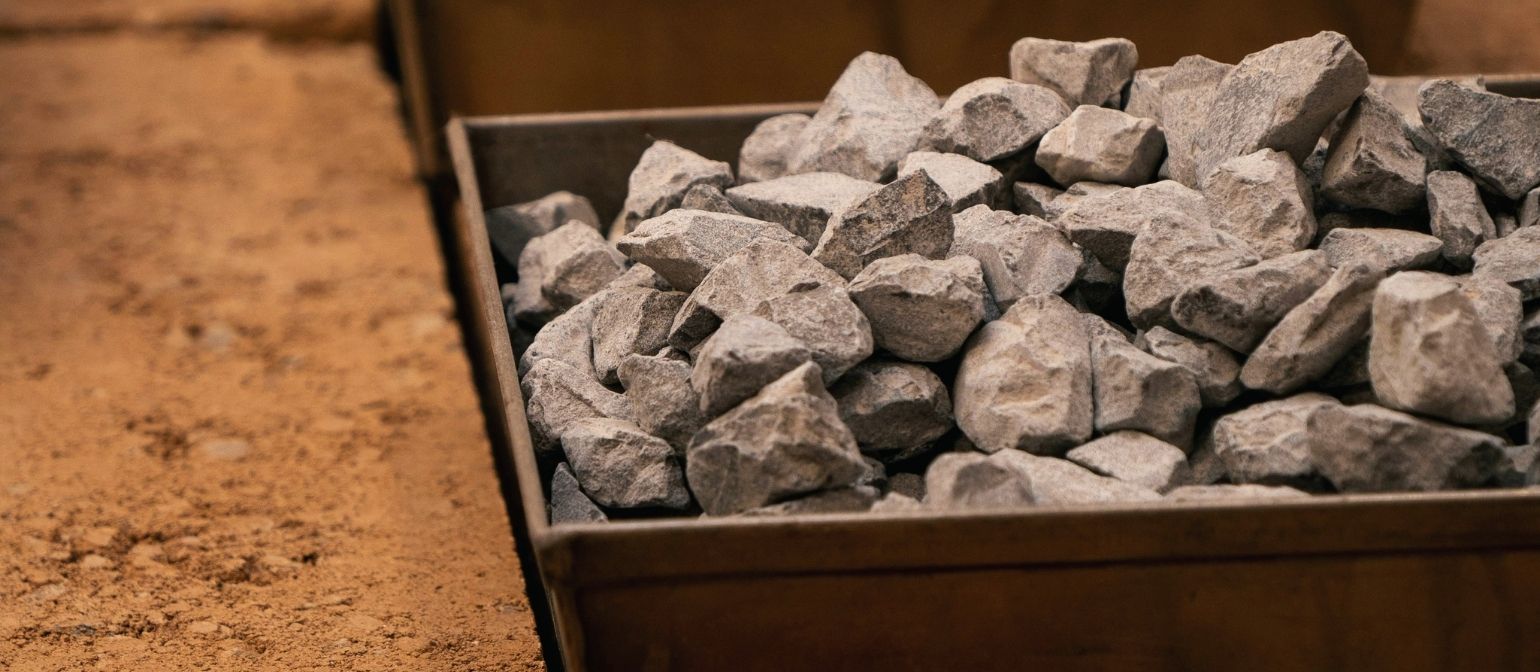
In 2025, total production of crushed aggregates, sand, and gravel, as well as limestone and marl for the cement and lime industries, amounted to 297.2 million metric tons—a 4.1% decrease from the previous year. At the same time, the outlook for demand in the coming years remains favorable. The implementation of major infrastructure projects, the use of European Union funds, and projects financed under the National Recovery Plan will increase the demand for aggregates, particularly those with specifications suitable for large-scale projects —as indicated in our latest report, “The Aggregates Market in Poland 2026.”
In 2025, sand and gravel accounted for approximately 58% of the extraction of the raw materials analyzed, crushed stone and block stone for 28%, and limestone and marl for the cement and lime industries for just under 15%.
Despite the decline in total production, the outlook for demand in the coming years is optimistic. Demand will be driven by road and hydropower projects, EU funds and the National Reconstruction Plan (in 2026), the development of military infrastructure, and the construction of a nuclear power plant in Lubiatowo-Kopalino. In 2025, spending on military infrastructure increased by 37% compared to 2023.
– In the coming years, the aggregates market will have to meet growing demand driven primarily by large-scale infrastructure investments. We forecast particularly strong growth in demand for crushed and block aggregates with specifications suitable for such projects. At the same time, regional imbalances between supply and demand, as well as the efficient organization of transportation, will pose challenges. The availability of rail lines and railcars is of particular importance. The timely transport of materials from stone quarries, especially in Lower Silesia, may present a significant challenge.
Szymon Jungiewicz
Head of Construction Market Analysis
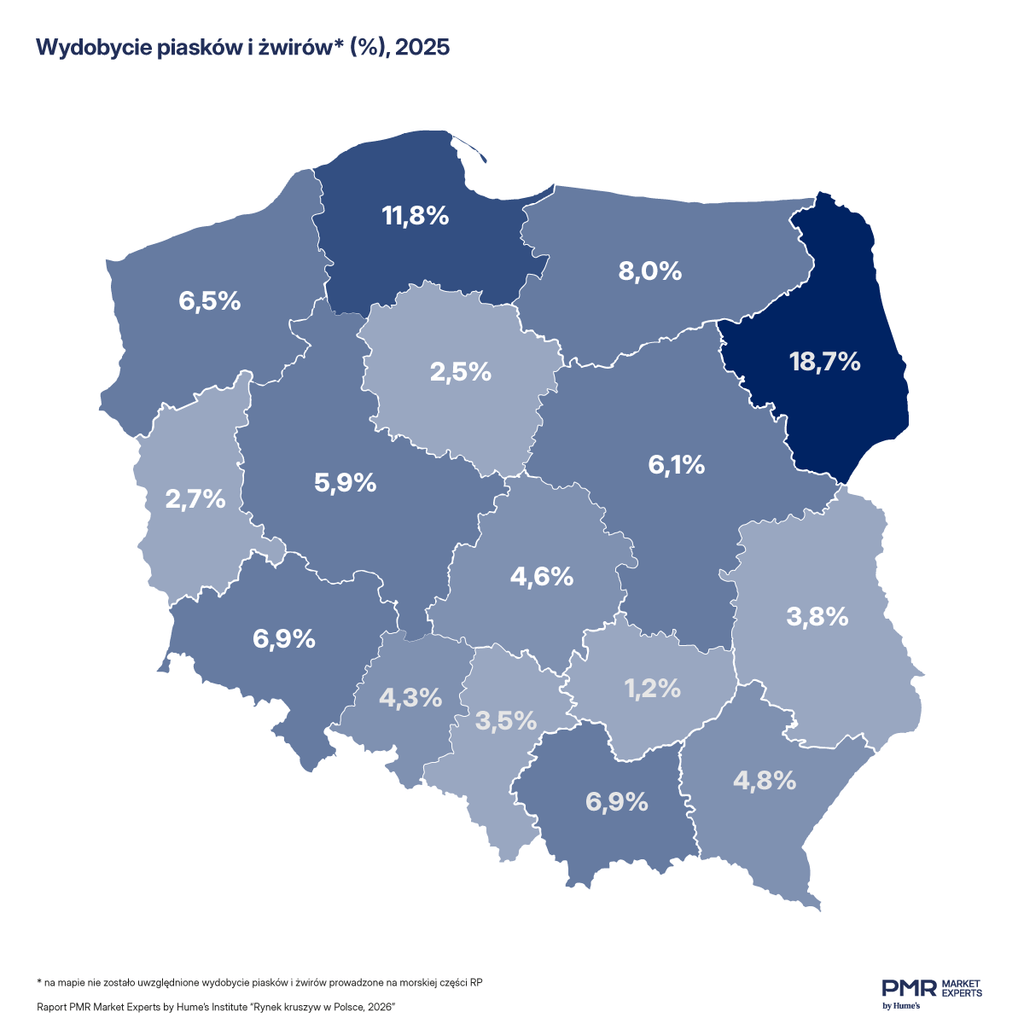
As our experts point out, aggregate mining in Poland varies significantly by region. Sand and gravel are distributed relatively evenly, although they are more prevalent in the northern part of the country. The highest extraction volumes for this group of raw materials were recorded in the Podlaskie and Pomeranian provinces. The situation is different for crushed stone and block stone. Their extraction is heavily concentrated in southwestern Poland, primarily in the Lower Silesian and Świętokrzyskie provinces. Limestone and marl for the cement and lime industries, on the other hand, are mined mainly in regions where the largest number of plants in these industries are located.
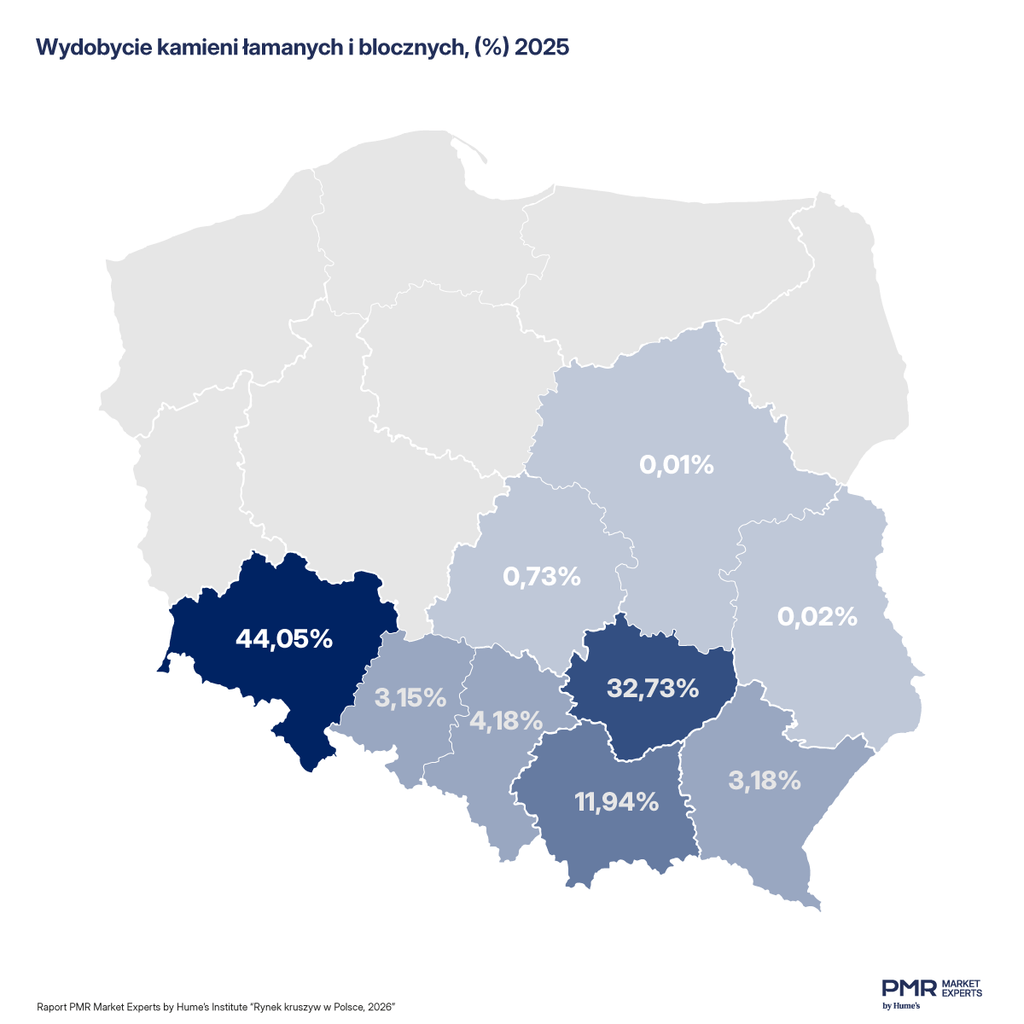
Significant regional variation is also evident in the distribution of raw material reserves. The country’s industrial reserves of crushed stone and block stone total approximately 3,998.8 million metric tons, of which as much as 93% is concentrated in three provinces: Lower Silesia — 68.1%, Świętokrzyskie — 13.9%, and Lesser Poland — 11%. Natural sand and gravel aggregates are distributed much more evenly, with industrial reserves exceeding 4.5 billion metric tons. Of this total, 3.7 billion metric tons are in developed deposits. This raw material is found in all provinces and in Poland’s maritime zone.
According to the report, the Podlaskie Voivodeship accounts for the largest share of the country’s sand and gravel reserves—nearly 15%. It is followed by the West Pomeranian Voivodeship (10.9%), the Pomeranian Voivodeship (10.3%), the Greater Poland Voivodeship (8.9%), and the Warmian-Masurian Voivodeship (8.3%). Together, these five regions account for more than half of the country’s raw material potential in this category. Significantly smaller shares were recorded in the Lesser Poland Voivodeship (3%), the Lublin Voivodeship (2.7%), the Silesian Voivodeship (1.8%), and the Świętokrzyskie Voivodeship (1.1%). In turn, Poland’s maritime area accounts for approximately 1.8% of the country’s sand and gravel aggregate reserves.
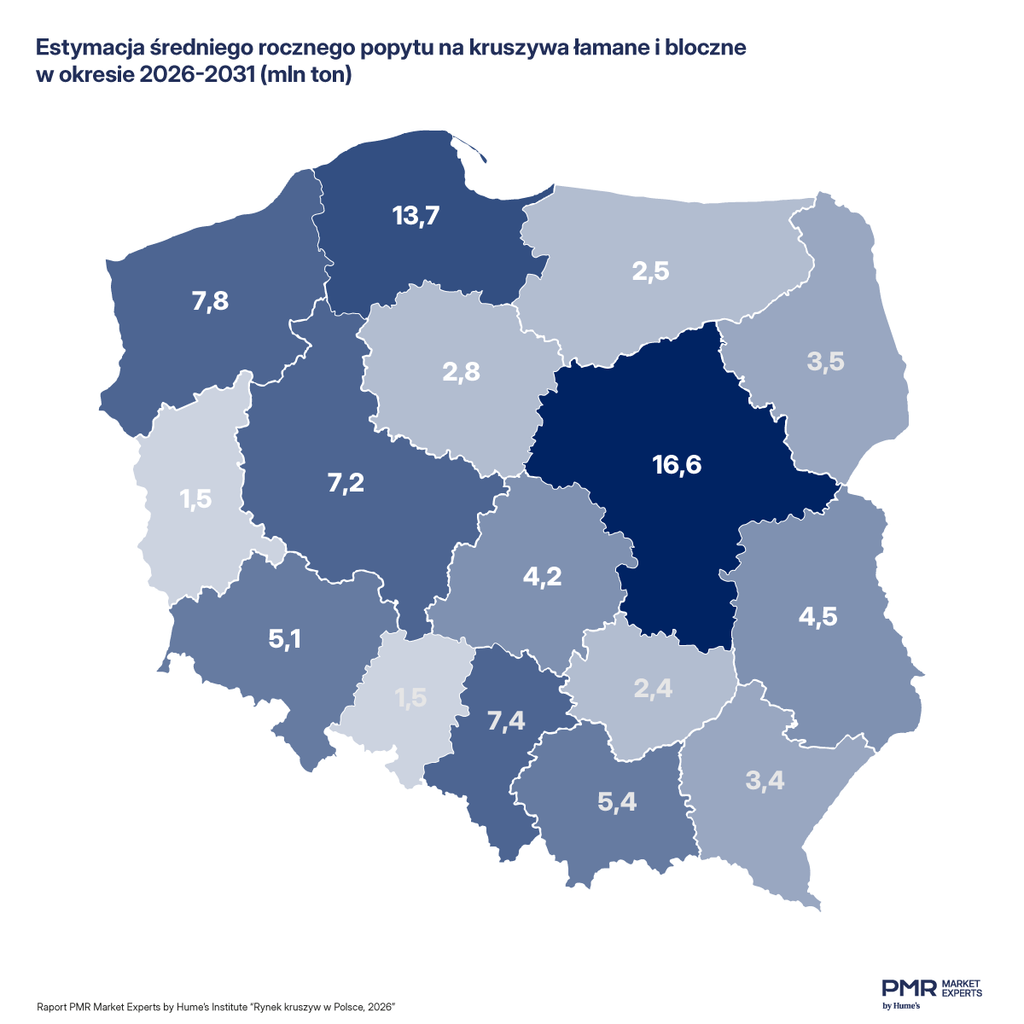
However, the distribution of resources does not correspond to the regional distribution of future demand. For crushed and block aggregates, the highest average annual demand for the years 2026–2031 is projected in the Mazowieckie Voivodeship—16.6 million metric tons—followed by the Pomorskie Voivodeship—13.7 million metric tons. The next highest demand is expected in the West Pomeranian Voivodeship—7.8 million metric tons, the Silesian Voivodeship—7.4 million metric tons, the Lesser Poland Voivodeship—7.2 million metric tons, and the Lower Silesian Voivodeship—5.1 million metric tons.
The Mazovia and Pomerania regions will together account for approximately 30% of the projected average annual demand for crushed and block aggregates in Poland. This high demand is primarily due to the concentration of construction and installation activity and the expected scale of infrastructure investments.
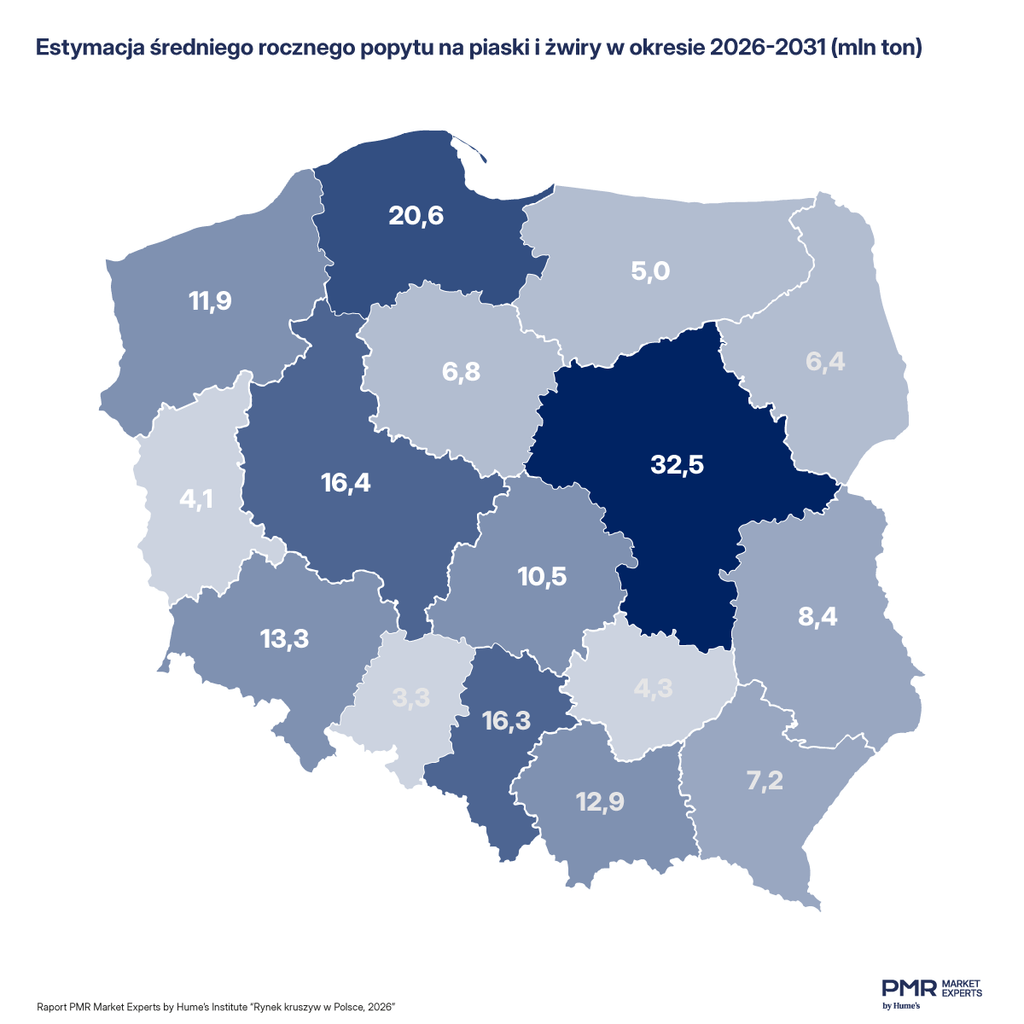
Even larger volumes will be needed for sand and gravel. According to forecasts, the average annual demand for 2026–2031 will be 32.5 million metric tons in the Mazovia Province and 20.6 million metric tons in the Pomerania Province. High demand is also expected in the Greater Poland Province —16.4 million metric tons, in the Silesian Voivodeship—16.3 million metric tons, in the Lower Silesian Voivodeship—13.3 million metric tons, in the Lesser Poland Voivodeship—12.9 million metric tons, and in the West Pomeranian Voivodeship—11.9 million metric tons.
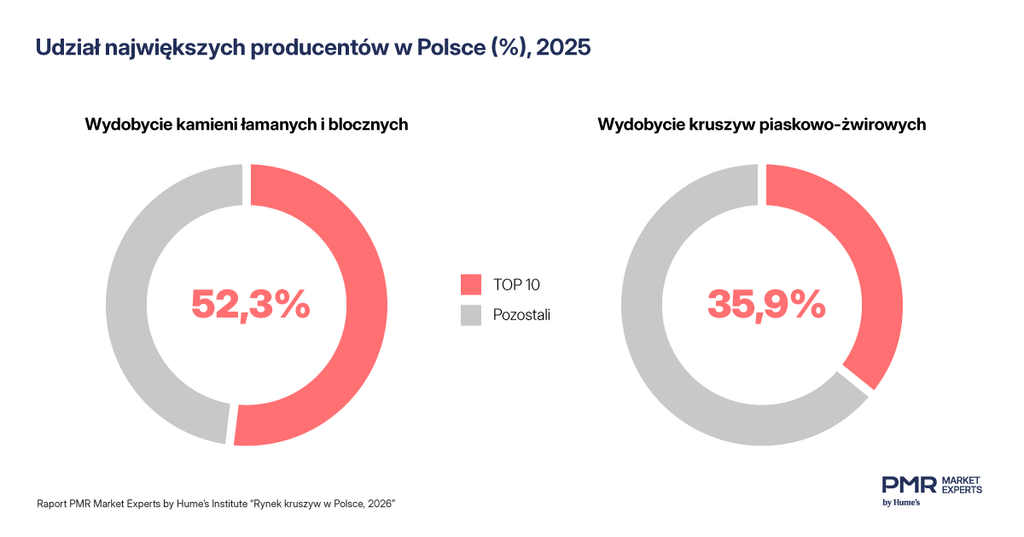
The market also varies in terms of producer concentration. In 2025, the ten largest producers accounted for 52% of total crushed and block aggregate production in Poland. In the case of sand and gravel, the market was more fragmented—the ten largest producers accounted for 36% of production.
– As a result, the aggregates market is entering a period in which growing demand is met by a raw material base that varies significantly by region. Particularly in the case of crushed and block aggregates, it will be crucial to efficiently link the mining potential of southwestern Poland with the markets where demand will be greatest in the coming years.
Szymon Jungiewicz
Head of Construction Market Analysis

Industry Report
Construction
OTHER BLOG POSTS: