
Industry Report
Construction
Construction sector in Poland 2026
Market analysis and development forecasts for 2026-2031
The construction market is the sector of the economy that, despite initial concerns, has not yet been significantly affected by the negative consequences of the COVID-19 pandemic. However, the major disruptions observed in other industries, changes in the commercial real estate market, and the financial problems faced by local governments are having a strong impact on the market’s outlook not only for the coming months but also for years to come.
In the second quarter of 2020, we experienced an unprecedented lockdown that affected both social life and the economy. As a result, for the first time in three decades, the Polish economy contracted. Under such circumstances, the role of the government and public investment becomes crucial. Hence the special role of infrastructure investments, which are currently serving not only as a stabilizing force for the construction market but also for the Polish economy as a whole.
Not only did the pandemic not derail road investment plans, but it actually strengthened the government’s determination to use this channel to drive the economy. These declarations are backed by additional funding—and substantial funding at that. The June update to the National Road Program allocated an additional 21 billion PLN, which will begin flowing into the construction market starting in 2022. In late August, a law was passed that will also provide more funding for local roads. The budget of the Local Roads Fund is set to be increased by 3.8 billion PLN before the end of this year. It should also be noted that work on Polish roads is currently in full swing. Expenditures by the General Directorate for National Roads and Motorways (GDDKiA) in each of the seven months summarized so far this year were higher than in the corresponding periods of 2019.
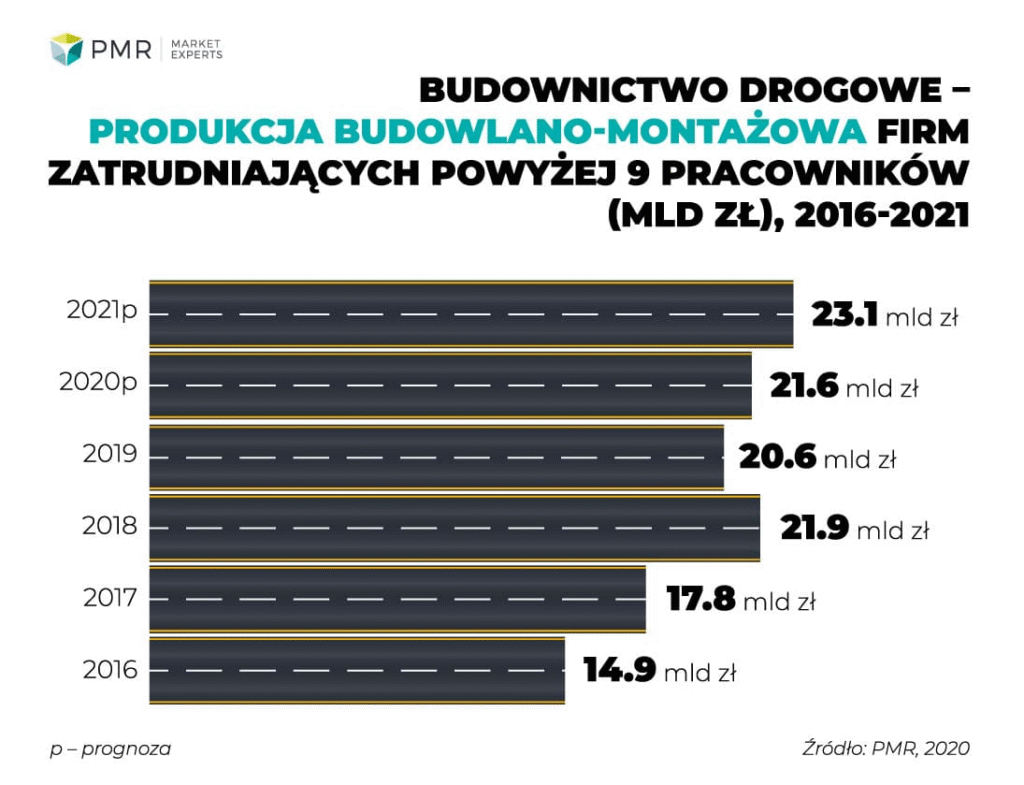
The National Railway Program has also been almost entirely implemented. According to the latest data from PKP PLK, investments worth over 51.3 billion PLN are currently underway (investment projects worth 13.9 billion PLN have already been completed, and additional projects worth 4.8 billion PLN are in the bidding process). Importantly, PKP PLK representatives have announced that they already have investment projects ready that extend beyond the current EU budget period—projects worth approximately 40 billion PLN are already prepared and are to be implemented under the traditional “build” system. They are merely awaiting the allocation of funding—there is therefore hope that there will be no investment gap once the current investment program is completed.
The government is also not backing down from its massive investment plans related to the construction of the Central Polish Airport (CPK). This involves not only a mega-airport but also rail lines connecting it to Poland’s major cities. The first contract has already been signed for work related to the environmental survey of the areas where the rail projects will be carried out (the Warsaw-Łódź route). The upcoming modernization of the Warsaw West station will already include an exit leading toward the CPK. The gross value added to GDP that this investment will generate for the Polish economy is 126 billion zlotys (for the construction phase), and the completion of all related components will require over a dozen years of construction work.

Industry Report
Construction
Market analysis and development forecasts for 2026-2031
OTHER BLOG POSTS:







