
Industry Report
Construction
Construction sector in Poland 2026 – Regional analysis
Market analysis and development forecasts for 2026-2031

Following growth of just under 6% in 2019, the construction market will maintain its current trajectory in 2020, although the growth rate will continue to slow. However, PMR Forecasts included in the PMR report “The Construction Sector in Poland – A Regional Analysis” indicate that the situation will vary significantly across individual provinces.
The main reason for the slower growth rate of the construction market in 2020 will be the high base of comparison resulting from the strong growth recorded in previous years. By type, each of the three construction segments will still show improvement compared to 2019. We expect relatively the least progress in the nonresidential construction segment, which is the most important due to its weight (over 41% of the entire construction market). By contrast, the outlook for growth in construction and installation output looks much better for civil engineering, which has also not yet reached its full potential. The momentum of infrastructure investments will continue and be further fueled by new projects entering the implementation phase. Residential construction still has the potential to post very strong statistics, which, combined with currently ongoing construction projects, will translate into moderate growth in completed construction and installation output in this segment of the construction market.
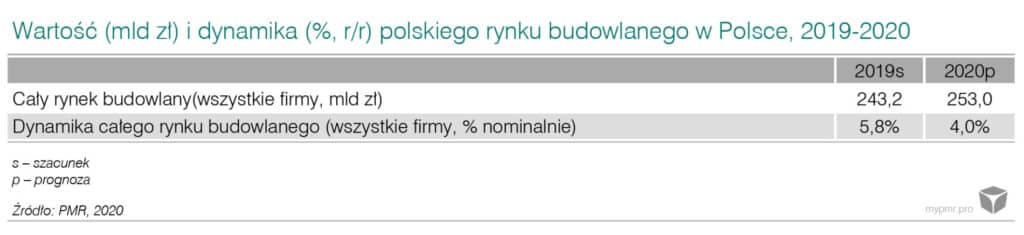
The good news is that in 2020, the value of construction and installation output (based on the location where the work is performed) will increase in every province compared to 2019. The rate of this growth will vary. Only in three provinces will the growth rate be minimal, not even exceeding 1% year-over-year. Moderate growth, ranging from 1% to 5% year-over-year, is expected to be the most common. We forecast this scenario for nine provinces. In two provinces, the growth rate of construction and installation output is projected to range between 5% and 10%. In the remaining two provinces, the construction market has the potential to achieve growth rates of even over 10%.
It is worth noting, however, that growth rates in individual regions depend not only on actual changes in investment activity. To a large extent, they are determined by the current size of the construction market. In provinces with the highest value of construction and installation output, achieving high growth rates is, in reality, incomparably more difficult than in regions where the construction market is several times smaller.
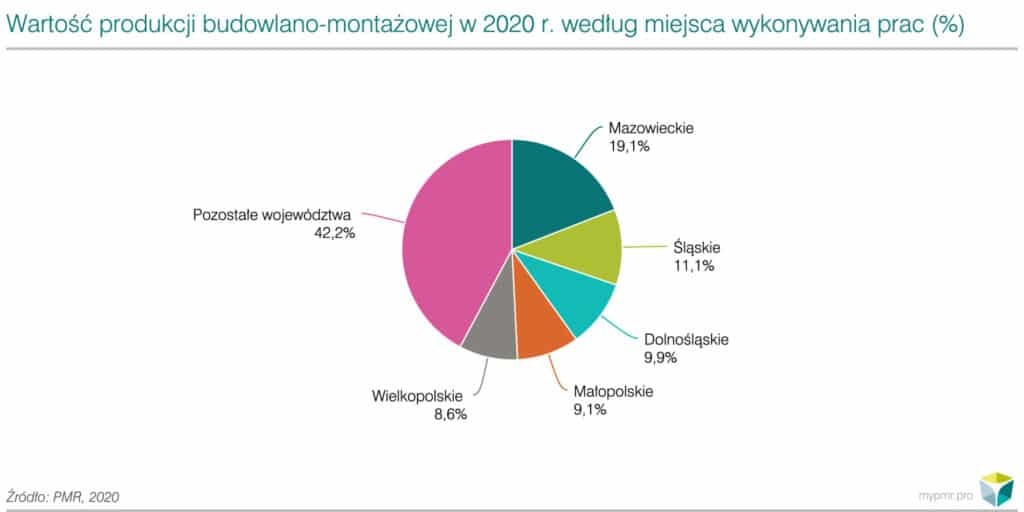
The standing of individual regions in terms of the volume of construction and installation work carried out within their borders is generally quite stable, as it is the result of long-term processes in the economic, demographic, and other spheres. Some regions have a significant advantage over others in many respects, including factors that directly and indirectly influence investment opportunities and the level of investor activity. For this reason, no major shifts should be expected in terms of the value of construction and installation output in these regions. In the coming years, there will be few changes in the regional construction landscape. This does not mean, however, that the construction development potential of individual provinces will be similar. Some of them will accelerate and close the gap with larger construction markets. Others, in turn, will lose their current pace of growth.
The assessment of construction potential in individual provinces will also vary depending on whether the segment of interest is residential, non-residential, or civil engineering construction. Due to their nature (being the most time-consuming and cost-intensive), investments in the civil engineering segment will have the greatest impact on the assessment of potential in individual provinces. Some provinces are still facing a backlog of work in this segment, while in others this backlog has already been addressed, and conditions are expected to stabilize somewhat in the coming years. It should be noted, however, that forecasts for this construction segment carry the greatest risk, stemming from delays, schedule changes, and actual costs—and sometimes even the complete abandonment of earlier plans. Therefore, the assessment of the development potential of individual provinces may undergo some changes in the future. In this context, systematic verification of actual results and potential updates to investment plans (including timelines and expected expenditures) will be of paramount importance. In this regard, the West Pomeranian and Lublin provinces stand out particularly positively.

Industry Report
Construction
Market analysis and development forecasts for 2026-2031
OTHER BLOG POSTS:







