
Industry Report
Digital & ICT
Pay TV and VOD market in Poland 2026
Market analysis and development forecasts for 2026-2031
The pay-TV market in Poland remains under significant pressure, and by 2031, the number of subscribers could drop by more than 1.5 million. At the same time, streaming services have reached maturity. More than 60% of households already use them, and the average family has 2.5 subscriptions. The way people use VOD services is also changing more and more noticeably. Users are switching between platforms, activating subscriptions when content that interests them becomes available. These are the findings of our latest report, “The Pay-TV and VOD Market in Poland.”
The Polish pay-TV market has been in a phase of gradual decline for several years. High service saturation, changing consumer habits, and growing competition from streaming platforms are causing more and more households to cancel their traditional subscriptions. An additional challenge is digital terrestrial television in the DVB-T2 standard—a free broadcasting standard that provides access to a greater number of channels without the need to pay a subscription fee. For some households, it serves as a sufficient alternative to pay TV.
– According to our research, 46% of households in Poland currently do not subscribe to pay TV. Importantly, not all of them are replacing it with free terrestrial television; instead, an increasing number are relying exclusively on online video services or giving up traditional television altogether. Declines in the market will be partially offset by the expansion of fiber-optic infrastructure and the growing popularity of bundled internet and TV packages. Nevertheless, our forecasts indicate that by 2031, the number of pay-TV subscribers will decrease by more than 1.5 million.
Jagoda Sitek
Market Analyst
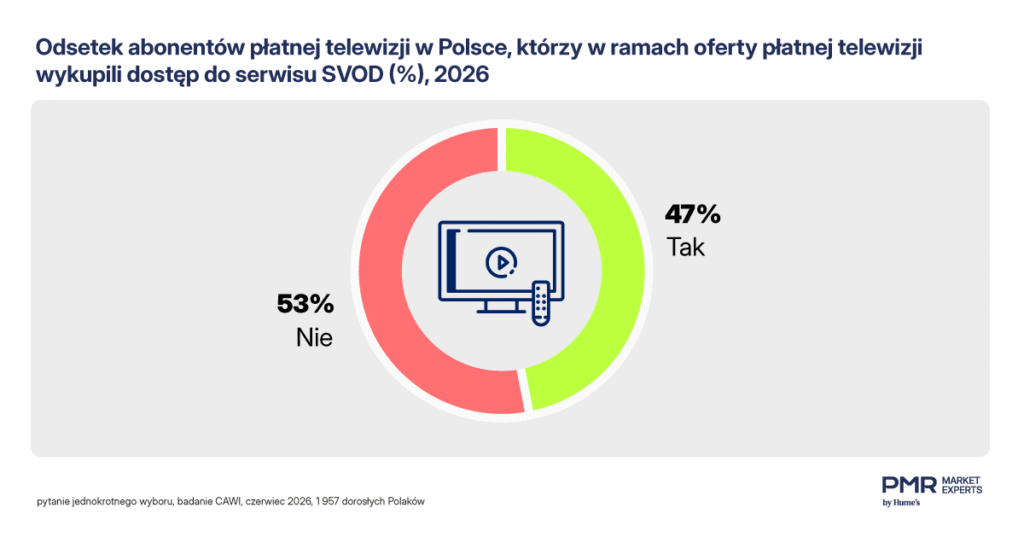
SVOD (Subscription Video on Demand) services—platforms that offer access to movies, TV series, and programs through a subscription model—remain the biggest beneficiaries of these changes. As our research shows, the main reasons for canceling paid TV subscriptions include factors such as:
It is these platforms that are competing more and more effectively for viewers’ time, offering extensive content libraries, original productions, and—increasingly—content familiar from traditional television channels.
The practice of using multiple platforms simultaneously is becoming increasingly common. Currently, the average household has 2.5 active SVOD subscriptions, choosing different services based on the movies, TV series, sports broadcasts, or documentaries available.
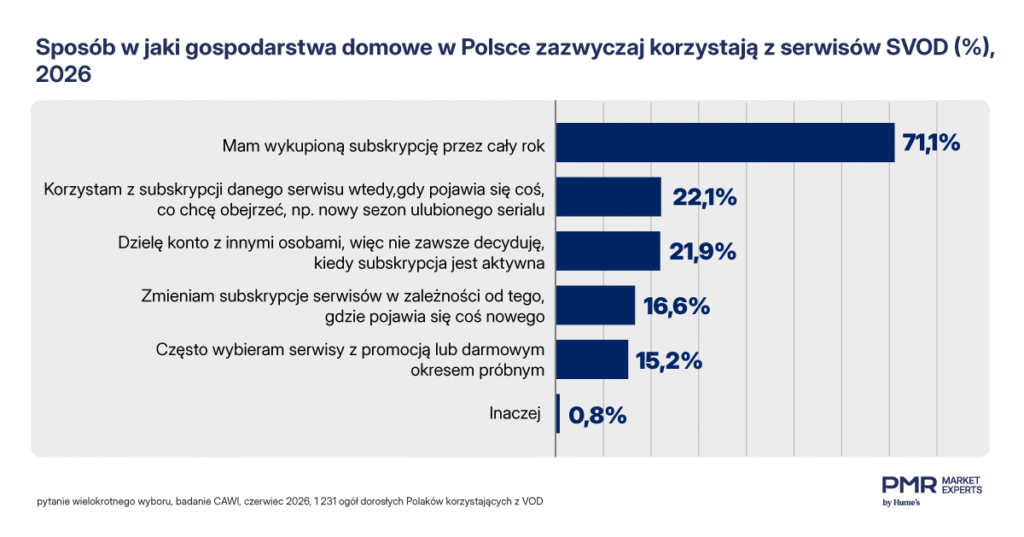
At the same time, the way people use these platforms is becoming increasingly flexible.
– Our survey shows that 22% of households only purchase a subscription when an interesting new release appears on the platform, rather than maintaining it throughout the year. We’re still happy to share accounts with family or friends.
Jagoda Sitek
Marker Analyst
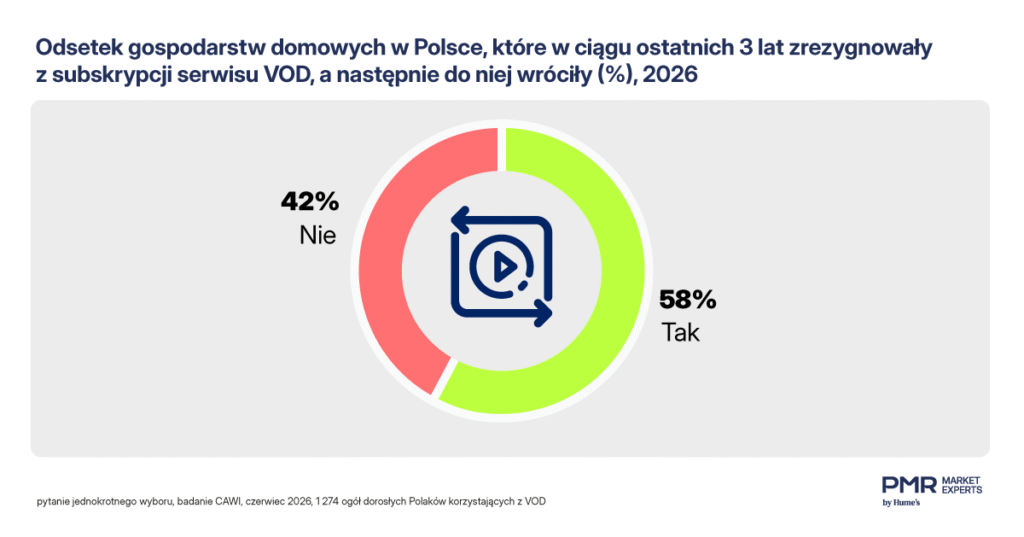
One of the most distinctive trends in the VOD market is the limited loyalty of users to individual platforms. Our analysis shows that over the past three years, more than 20% of subscribers have switched VOD platforms, migrating between competing services. The most important drivers for this change are attractive promotions and lower subscription prices, which even outweigh the selection of movies and TV shows. Importantly, canceling a subscription increasingly rarely means the customer is leaving for good. As many as 58% of users have re-subscribed to a service they had previously canceled.
– The Polish VOD market is increasingly resembling a market of “rotating subscribers.” Users do not stick to a single platform but flexibly manage their subscriptions, tailoring them to current content offerings and promotions. For providers, this means that effectively re-acquiring customers through the right pricing strategy, new releases, and attractive service packages is becoming just as important as acquiring new customers.
Jagoda Sitek
Marker Analyst
In the coming years, the VOD market will continue to grow, primarily due to the expansion of paid subscription platforms. This growth will be driven by both increases in subscription prices and changes in operators’ business models—such as limiting account sharing and the development of cheaper ad-supported packages. VOD sales by telecommunications operators are already a permanent feature of the market and will gradually gain in importance in the coming years. Operators will increasingly incorporate streaming services into their internet and television service bundles to drive sales and retain customers, particularly television subscribers.
According to our experts’ forecasts, the number of households using VOD services but without pay TV will continue to grow steadily. At the same time, SVOD penetration will remain higher than pay-TV penetration, confirming a lasting shift in how Poles consume video content.

Industry Report
Digital & ICT
Market analysis and development forecasts for 2026-2031
OTHER BLOG POSTS:







