
Industry Report
Retail
Raport prognostyczny: Rynek handlu detalicznego artykułami spożywczymi w Polsce 2026
Sezonowość, koncentracja i implikacje dla biznesu

PMR’s Forecasting and Econometric Modeling Department has prepared the latest forecasts for the Polish economy. These forecasts cover areas such as the overall macroeconomic outlook, inflation, investment, the labor market, household finances, and demographics.
Following a significant slowdown in real GDP growth in 2023 to 0.2% year-over-year, the Polish economy will accelerate significantly in 2024, reaching a growth rate of approximately 3% year-over-year. 134.6. This means, however, that it will continue to grow at a rate slightly below its potential. Faster growth will not occur until 2025, but it should not significantly exceed 4% year-over-year. from
The acceleration in growth in 2024 will be driven primarily by a rebound in consumption, supported by lower inflation and a marked increase in real disposable income. Investment growth in 2024, however, will be limited due to the transition year between EU budget frameworks and the expected decline in local government investment spending related to the election cycle. Stronger growth will also be held back by the unfavorable economic situation in Germany, which is limiting the outlook for Polish industry and exports.
Starting in 2025, however, investments—supported by funds from the National Reconstruction Plan—will also accelerate, and the Polish economy will grow at a rate equal to or even higher than its potential.
PMR Forecasts: GDP per capita and real GDP growth in Poland, 2016–2029

In the first quarter of 2024, inflation continued to decline, reaching 2% in March. As a result, the average inflation rate for the first half of 2024 will be below 3%. This trend continues to be supported by base effects, deflation in the industrial sector, deflationary trends in China, a zloty that has strengthened against the euro and the dollar, and the economic situation in Germany and the eurozone. Starting in April 2024 (2.4%), inflation will rise slightly again and stabilize in the 3–5% range. Further (in 2025 and beyond) smooth declines in inflation will be hampered by persistently high wage pressures. A sustained return to the inflation target (2.5% ± 1 percentage point) will not occur until 2026.
There are still many risks surrounding inflation in Poland that could trigger another sharp rise and further prolong the process of bringing it down. These include, among others, the ongoing war in Ukraine, the Monetary Policy Council’s (RPP) decisions on interest rates, the implementation of pro-inflationary campaign promises, energy and agricultural commodity prices, the weakening of the Polish currency, and strong wage pressure in the labor market.
PMR Forecasts: CPI Inflation (%, y/y), 2016–2029

We forecast stagnation in capital expenditures in 2024, followed by strong growth again starting in 2025. In 2024, investment performance will be negatively impacted by the fact that this is a transitional period between EU budget frameworks, a situation that will not be offset even by the launch of the National Recovery Plan (KPO). The election cycle will also have a negative impact—the largest local government investments occurred in 2023 and at the turn of 2023/2024. 4.9%.
Starting in 2025, investment will grow steadily and increase its share of GDP—driven by significant investment needs (in the energy sector), the availability of financing (EU funds, lower interest rates than at present), steadily growing domestic demand, and a solid inflow of foreign direct investment.
On the other hand, strong growth in investment starting in 2025, in an environment of high wage pressure and low labor availability, may pose the risk of renewed price increases for, among other things, construction services and materials, and, consequently, in other sectors of the economy as well.
PMR Forecasts: Real Investment Growth in Poland (%, y/y), 2016–2029

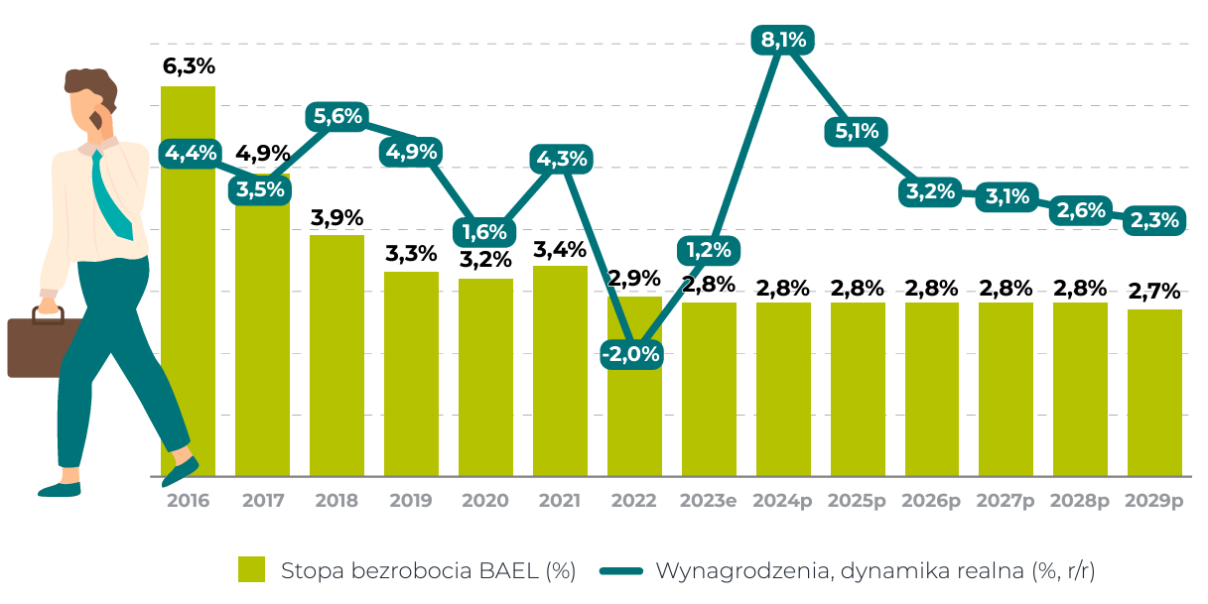
The job market remains in very good shape from the employee’s perspective. Despite numerous risks, the unemployment rate remains very low and is currently one of the lowest in the EU.
We forecast that in 2024, wages will rise sharply in real terms, by as much as approximately 8% year-over-year. This will be driven by a decline in inflation, an increase in the minimum wage, pay raises for public-sector employees and teachers, and a moderate rise in labor productivity. In the coming years, wage growth will stem mainly from the continued low unemployment rate.
The unemployment rate, on the other hand, will remain at a low, stable level from 2024 to 2029. This will result from strong economic activity and unfavorable demographic trends. It will have a positive impact on consumer income and sentiment, but from the perspective of employers and manufacturers, the impact will be negative—wage pressure will remain strong.
Potential continued, strong, and sustained nominal wage growth, without a corresponding increase in labor productivity, poses a significant risk to the Polish economy in the medium term
PMR Forecasts: Average Annual BAEL Unemployment Rate and Real Growth Rate of Average Monthly Gross Wages in Poland, 2016–2029
We forecast that Poles’ disposable income will grow—by approximately 7.5% in 2024 and then at a rate of about 3–4% year-over-year—which will have a positive impact on consumer spending. This trend will be significantly influenced by the increase in the 500+ benefit to 800 zł, the permanent introduction of the 14th pension, the introduction of the so-called “grandmother’s allowance” (the “Active Parent” program), and the potential fulfillment of other campaign promises. Above all, however, strong growth in disposable income and consumption will result from conditions in the labor market as well as declining inflation and interest rates.
Potential further migration flows pose a risk to the accuracy of the forecasts. A potential additional influx of refugees from Ukraine to Poland (due, for example, to an intensification of hostilities) would lead to stronger growth in private consumption and support stronger market growth. Conversely, mass returns of Ukrainian citizens to their homeland would result in weaker private consumption and slower market growth.
PMR Forecasts: Real growth rates of household disposable income and private consumption in Poland (%, year-over-year), 2016–2029

The resident population of Poland is clearly declining. Between the 2011 and 2021 National Censuses, it fell by nearly 3% (more than one million people). Furthermore, changes in the demographic structure are also unfavorable.
We project that adverse demographic trends will continue over the forecast horizon. The number of births will continue to hover around historic lows. The resident population will decrease by 1.7% by 2029, from 37 million to 36.3 million people. The percentage of people of working age (from age 18 until retirement) will decrease, while the percentage of people of post-working age will increase. By 2029, more than 25% of Poland’s population will be of post-working age, representing an increase of approximately 2 percentage points compared to 2022.
A significant risk factor for the accuracy of the forecasts is the situation regarding the migration of refugees from (or to) Ukraine, as we described on the slide concerning the population’s economic situation.

Source: GUS (historical data), PMR analysis (forecast), 2024
p – forecast

Industry Report
Retail
Sezonowość, koncentracja i implikacje dla biznesu
OTHER BLOG POSTS:







