Industry Report
Construction
Construction sector in Poland 2026
Market analysis and development forecasts for 2026-2031
According to the findings of the latest PMR report, titled “The Cement Market in Russia, Ukraine, Belarus, and Kazakhstan 2020.” “Growth Forecasts for 2016–2021,” cement production in these four countries rose by 5.5% to 81.6 million metric tons in 2019, following a decline of nearly 1% recorded the previous year. This rebound was driven primarily by Russia, which accounted for 71% of the region’s cement production last year.
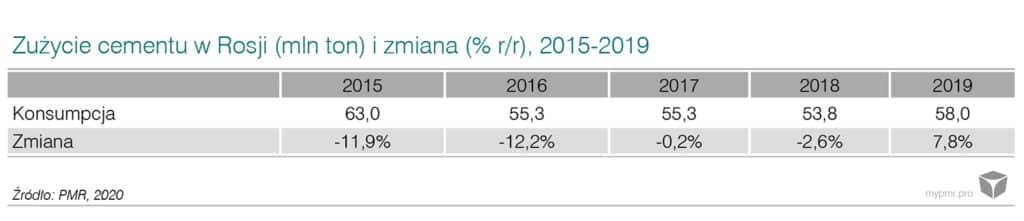
In Russia, cement production grew steadily between 2010 and 2014 at a CAGR of 9.2%, driven primarily by significant growth in residential and nonresidential construction. In 2015 and 2016, production decreased by 10% and 11.6%, respectively, followed by further declines in 2017 and 2018. It is estimated that cement production in 2018 totaled 53.3 million metric tons, excluding approximately 400,000 metric tons produced in Crimea, representing a 2% decline from the previous year’s level. Furthermore, cement imports are estimated to have decreased by nearly 28% year-over-year to approximately 1.5 million metric tons. Nevertheless, most of the cement consumed is produced locally, and imports account for less than 7% of domestic consumption. According to PMR estimates, cement consumption in Russia amounted to approximately 53.8 million metric tons in 2018, which was 2.6% less than the previous year. Nevertheless, in 2019, the Russian cement industry returned to an upward trend, with production and consumption rebounding by 7–8% year-over-year.
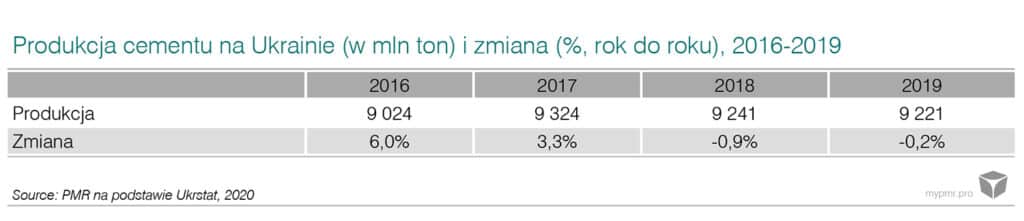
In Ukraine, the cement industry has also been on a downward trend in recent years, despite the official sharp increase in construction output. In 2018, cement production decreased by 0.9%, following a 3.3% increase the previous year and a sharp upward trend in the construction sector. In 2019, however, the downward trend returned, although the decline was only 0.2%.
From 2017 to 2019, the construction sector in Ukraine continued to feel the effects of the crisis in the eastern part of the country, albeit to a lesser extent. In addition, a significantly lower devaluation of the national currency and easing inflation helped reduce borrowing costs. Annual GDP growth of at least 2.5% since 2017, the stabilization of the national currency against the euro (following a 14% decline in 2016 and a 35% decline in 2015), and an average consumer price index of 8% in 2019 (a gradual easing from 48.7% in 2015), supplemented by a sharp increase in the value of personal remittances, provided solid support for construction activity in 2017–2019. Official data indicate that construction output in Ukraine recorded a cumulative price increase of 64% between 2017 and 2019. This increase occurred mainly in the civil engineering subgroup, which recorded an 85% year-over-year increase. The nonresidential construction subgroup also recorded solid growth during this period, amounting to 70%. Residential construction output rose by “only” 21%. However, this recent increase did not trigger a significant upturn in cement production, mainly because that production was driven by transportation infrastructure projects, which do not involve significant consumption of raw materials.
Unlike in Russia and Ukraine, the cement industry in Kazakhstan is one of the sectors that has been experiencing a real boom in recent years. Since 2010, large-scale, state-supported infrastructure programs have been launched, in particular the State Program for the Accelerated Development of Industry and Innovation. In 2019, cement production in Kazakhstan reached a record high of 9.92 million metric tons. Year-over-year, production increased by just 0.7%, and by 22% compared to the level reached in 2014. Our estimates indicate that cement consumption in Kazakhstan rose by 2.1% year-over-year in 2019, following a decline of nearly 5% the previous year.
As for Belarus, recent developments in the domestic cement industry have caused significant financial difficulties for domestic cement companies. Modernization required investments totaling over $1 billion, most of which were financed by loans from Chinese investors. The financial difficulties faced by the three cement producers in Belarus are primarily due to a lack of export growth, the devaluation of the national currency, and a decline in domestic demand. Weak growth in the residential and nonresidential construction sectors in Belarus, coupled with a lack of export growth to Russia and Ukraine, provided only modest support for the expansion of the cement market between 2015 and 2019. Nevertheless, domestic cement production reached 4.73 million metric tons in 2019, the highest level since 2014.

Industry Report
Construction
Market analysis and development forecasts for 2026-2031
OTHER BLOG POSTS: