Industry Report
Retail
Handel internetowy w Polsce 2026
Analiza rynku e-commerce i prognozy rozwoju na lata 2026-2031

After a record-breaking period, Poles’ shopping on foreign platforms such as Temu, Shein, and AliExpress is slowing down significantly. This is primarily due to changes in EU customs regulations, rising prices, and the gradual saturation of demand for products offered by Asian websites. However, according to the latest report by PMR Market Experts by Hume’s, “E-commerce in Poland 2026,” this does not mean that the outlook for the e-commerce sector as a whole is bleak. Domestic e-commerce platforms and comprehensive online stores will take over the demand, and the market is projected to grow at an average annual rate of approximately 8% through 2031.
The years 2022–2025 were a record-breaking period for the cross-border segment of the Polish e-commerce market. Purchases on foreign platforms grew at an average annual rate of nearly 20%, and in 2025, growth exceeded 30%.
This was driven by the platforms’ aggressive pricing and promotional strategies, a very broad product range, and the growing recognition of Chinese e-commerce sites. The rapid expansion of Temu and Shein—supported by heavy marketing spending and increasingly convenient delivery options—also played a significant role.
The year 2026 brought a marked slowdown. The price advantage of Asian platforms began to diminish, and other players are competing more and more fiercely on price, product offerings, and delivery speed. According to PMR Forecasts by Hume’s, sales growth in the cross-border sub-channel will be in the low single digits in 2026 and will give way to both e-commerce platforms and online stores.
– Cross-border platforms that rely on very low-cost products and shopping carts with many items will be hit hardest by the slowdown. It is precisely in their business model that the new costs at the EU border are felt most acutely.
Agnieszka Skonieczna
, Head Retail Market Analyst
A key factor driving these changes is the EU customs reform, which is gradually increasing the cost of importing small packages. Starting July 1, 2026, goods in shipments valued at up to €150 will be subject to a temporary duty of €3, calculated based on tariff lines. By November 1, 2026, at the latest, an additional fee for customs processing of small e-commerce shipments is to be introduced, the amount of which will be determined by the European Commission. Furthermore, starting July 1, 2028, the EU Customs Data Hub is scheduled to launch, and there will be a transition from the flat rate of €3 to standard duties based on product type, including for imports valued at less than €150.
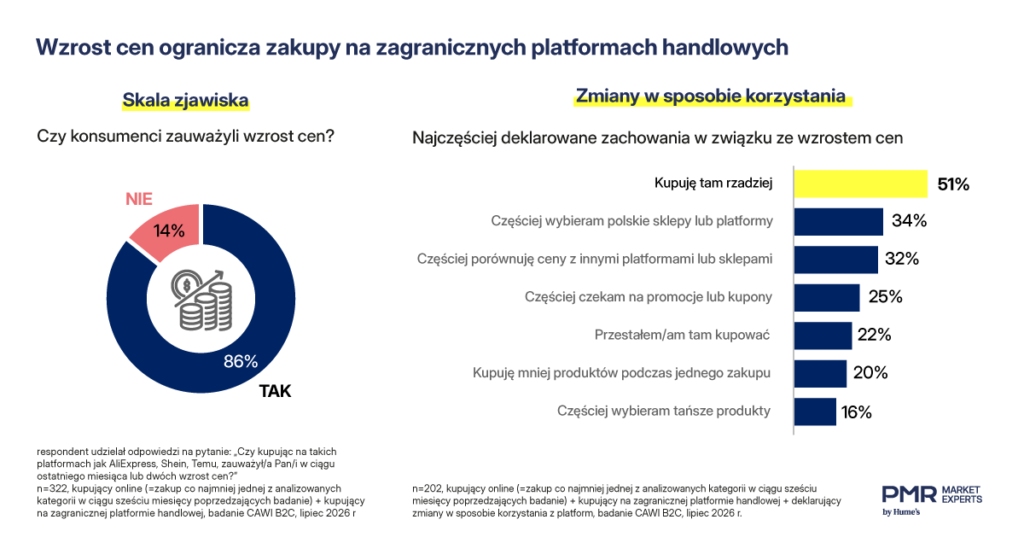
Consumers are already reacting to these changes. A survey by PMR Market Experts by Hume’s shows that 86% of online shoppers have noticed price changes on cross-border platforms, and 82% say they have changed how they use foreign platforms in response to the price increases. They are shopping there less frequently, choosing Polish stores and platforms more often, and comparing prices with other offers more frequently.
A slowdown in cross-border e-commerce will not weaken the outlook for the market as a whole, as demand will be absorbed by other channels. According to PMR Forecasts by Hume’s, the e-commerce market in Poland will grow at an average annual rate of approximately 8% between 2026 and 2031.
E-commerce platforms will remain the most promising channel. Their growth will be driven by the increasing number of sellers and the breadth of the product offering, the development of marketplace models by large online retailers and omnichannel networks, and the capture of a portion of cross-border demand. Comprehensive online stores, which compete with Asian platforms on price and product variety, will also benefit from these changes.
– The slowdown in cross-border e-commerce is not a hindrance to Polish e-commerce, but rather a restructuring of the sector. Customers who are shopping less frequently on Asian platforms aren’t giving up on online shopping; they’re simply looking for similarly attractive prices and a wide selection from other retailers. Those who combine competitive pricing with fast and convenient delivery will gain the upper hand.
Agnieszka Skonieczna
, Head Retail Market Analyst
New customers will also drive the market. According to PMR Forecasts, by 2031 nearly 87% of Internet users aged 16–74 will be shopping online. Penetration will grow fastest among the 55–74 age group, where the percentage of online shoppers will increase by nearly 15 percentage points between 2025 and 2031.
Over the next few years, the most promising categories will be household chemicals, pet products, and jewelry, which are expected to grow at a double-digit CAGR between 2026 and 2031. By contrast, children’s products have the weakest outlook, which is a direct result of unfavorable demographic trends.

Industry Report
Retail
Analiza rynku e-commerce i prognozy rozwoju na lata 2026-2031
OTHER BLOG POSTS: