Industry Report
Digital & ICT
Mobile internet and value-added services market in Poland 2026
Market analysis and development forecasts for 2026-2031

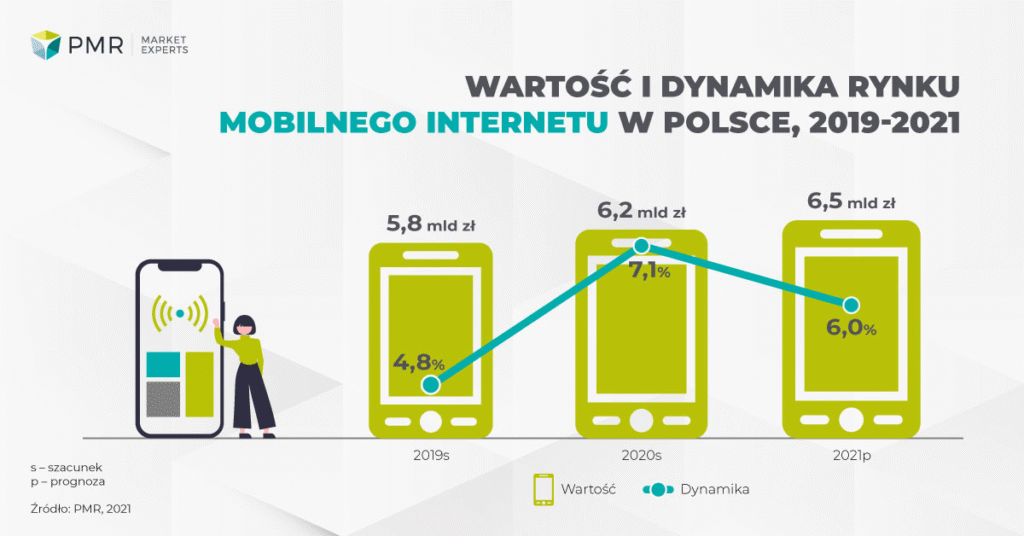
PMR estimates the value of the mobile internet market in Poland in 2020 at 6.2 billion PLN. On an annual basis, this represents a 7% increase. Meanwhile, the projected CAGR for the market value from 2021 to 2026 is 4.9%. Operators’ greatest revenue potential lies in the “data” services segment for smartphones.
However, dedicated access services are losing ground, with the exception of fixed-location offerings. The degree of monetization of 5G services in Poland is currently up for debate—it all depends on the pricing policies adopted by operators and the distribution of data packages in dedicated access (whether access is limited or not).
According to PMR data, in 2020 the value of the Polish mobile internet market grew by 7% year-over-year, reaching 6.2 billion PLN, accounting for one-quarter of mobile operators’ total revenue. The market’s performance is being driven by both volume trends and rising or stable ARPU per service. Data services on mobile phones are the key market segment driving its value.
Conversely, mobile Internet in the dedicated access model, as a product category, is losing ground due to the growing popularity of mobile Internet services included in voice plans for smartphones and competition from fixed-line connections. However, mobile broadband offerings for fixed locations (for home/office), which are classified as direct substitutes for traditional broadband, are acting as a stabilizing factor in the dedicated access segment.
The COVID-19 crisis had a neutral-to-positive impact on the value of the mobile internet market in Poland. The core business of mobile telecom operators remains relatively resilient to the effects of the pandemic. An important factor underpinning the market’s position during the crisis is its maturity and high penetration of services—particularly data transmission—as well as its reliance on subscription-based services, which ensures relative stability and predictability of revenue streams.
However, the pandemic has, to some extent, accelerated the growth in the number of users accessing the internet on smartphones and expanded the group of “heavy users”—that is, those who use the internet daily to access an ever-increasing number of digital services (primarily audio and video streaming and gaming). This had a positive impact on the overall market value.
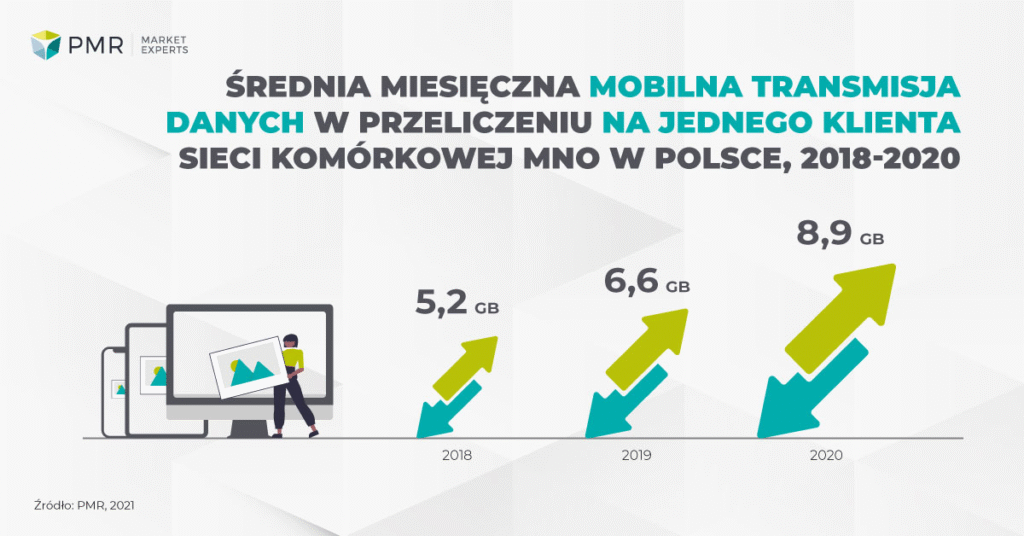
The growth in the number of users accessing the Internet via mobile devices accelerated in 2020. As a result, by the end of last year, more than 20 million Poles aged 15 and older were using mobile data on their smartphones. Market volume is driven by a number of key factors, such as the growing popularity of data services on smartphones, the development of LTE, LTE-Advanced, and 5G technologies, a wealth of digital content designed for mobile devices, and customer loyalty through subscription plans.
At the same time, ARPU from mobile data transmission in the mobile phone segment is growing. The main drivers are the 2019 price increases for mobile services, 5G plans and operators’ focus on building revenue value, growing demand for mobile data (primarily on smartphones), the consumption of increasingly larger data plans, and the migration of prepaid customers toward postpaid plans.
Despite the declining importance of the mobile Internet segment in the dedicated model (“modem/SIM card + computer”)—due to competition from smartphone data plans and traditional broadband— PMR anticipates further growth in the number of such connections in 2020. The relative popularity of plans intended for stationary use has a positive impact on the volume of the dedicated mobile Internet market. Their appeal stabilizes the market and protects it from declines.
PMR estimates that the penetration rates for mobile and traditional broadband are at similar levels—a result of the complementary nature of these services, the expansion of fiber-optic networks, and the underdeveloped fixed-line infrastructure outside major cities. However, PMR sees a competitive advantage for fixed-line connections when it comes to consumer preferences regarding internet service parameters. In the case of fixed-line access, the key advantage is the gradual rise in the importance of fiber-optic networks as an access technology, even outside major cities.
ARPU from “data” services in the “modem/SIM card + computer” segment has shown a slight downward trend in recent years, with a tendency toward stabilization. Customers of these services are more price-sensitive compared to mobile data on phones. In addition, there is competition from fixed-line Internet services. However, sales of mobile Internet plans for fixed locations (home/office plans) have a stabilizing effect on the ARPU metric.
For 2021–2026, PMR forecasts that growth trends in the mobile internet market in Poland will continue, both in terms of quantity and quality. In terms of volume, however, the year-over-year growth trend will slow. This will largely be a result of market saturation and economies of scale, which limit further expansion. Consequently, the number of mobile internet subscriptions will tend toward stagnation.
Over the next six years, according to PMR’s forecasting model, the value of the mobile internet market in Poland will grow at an average annual rate of 4.9%. Growth trends will be concentrated primarily in the mobile data segment—driven by the implementation of the “more-for-more” strategy, rising mobile data consumption on smartphones, and the cyclical sales of voice plans that include 5G access.
On the other hand, PMR does not expect a sharp increase in mobile operators’ data transmission revenues during the forecast period due to the development of 5G technology. PMR believes that in the coming years, following marketing positioning efforts, 5G plan prices will be reduced. In conjunction with the gradual transition of users to fifth-generation technology, this will not cause any dramatic shifts in the market in terms of value. Similarly, in connection with the development of 5G networks, PMR does not foresee a mass shift among Poles toward mobile connections via the “modem/SIM card + computer” method. A constraint on such a trend is the continued importance of fixed-line connections and the growing significance of fiber-optic technology. Furthermore, PMR maintains that 5G connectivity will revolutionize the Polish economy, rather than the consumer market. On the other hand, a certain impact of 5G technology on service ARPU and market value is evident in the marked forecasts.

Industry Report
Digital & ICT
Market analysis and development forecasts for 2026-2031
OTHER BLOG POSTS: